
NCDEQ Neuse and Tar-Pamlico River Basins Riparian Buffer Rules
Understanding Buffer Rules
What Are Riparian Buffers?
The word riparian refers to the banks of streams, rivers, lakes, estuaries or other waters. A healthy riparian buffer has a combination of woody vegetation, shrubs, herbs, and native grasses growing on it to keep streambanks in place, remove unwanted pollutants, create healthy critter habitat, and reduce flooding. Riparian buffers are managed as one or more zones. The zone closest to the water protects the streambank and shoreline from erosion. The outer zone slows and spreads out the flow of stormwater, and traps pollutants before they enter the body of water.

Purpose of the Neuse and Tar-Pamlico Buffer Rules
To maintain and protect existing riparian buffers and maintain their nutrient removal functions to protect streams, lakes and estuaries.
Learn more about buffer applicability
If you are unsure if the riparian buffer rules apply to your property/project, check the Applicability section of the specific Rule. List of the buffer rules: deq.nc.gov/ncbufferrules
Use the mapping resources on the DWR main Buffer Rules page to help identify buffered water bodies: deq.nc.gov/ncbufferrules
Have questions? Contact your Local Government or the NC Division of Water Resources: deq.nc.gov/ncbufferrulescontacts
To learn more about buffers, and for additional educational and training resources, visit: deq.nc.gov/bufferrules
Benefits of Riparian Buffers
PROVIDE PROTECTION
- Remove nutrients
- Filter sediment
- Trap pollutants
- Reduce erosion
- Slow velocity of runoff, allow infiltration
- Reduce economic loss from floods
PROVIDE HABITAT
- Home to plant and animal species
- Shade- thermal protection of stream
- Provide large woody and leaf debris (instream habitat and food) PROVIDE AESTHETIC VALUE
- Absorb noise from waterfront activities
- Provide privacy
- Provide recreational value such as fishing and birdwatching
PROVIDE AESTHETIC VALUE
- Absorb noise from waterfront activities
- Provide privacy
- Provide recreational value such as fishing and birdwatching
Where do the buffer rules apply and why?
The riparian buffer rules apply to the following types of water bodies that are shown on the most recent published version of the soil survey maps prepared by the NRCS or the most recent USGS 1:24,000 scale quadrangle topographic maps:
- Perennial streams
- Intermittent streams
- Most modified natural streams
- Lakes and reservoirs
- Ponds (including beaver ponds), not including agriculture ponds
- Rivers and Estuaries

How are riparian buffers measured?
Streams: measured landward from the top of the bank or from the rooted herbaceous vegetation on each side of the stream.
Ponds, lakes and reservoirs: measured from the normal water level.
Estuaries: measured landward from the normal high water or normal water level
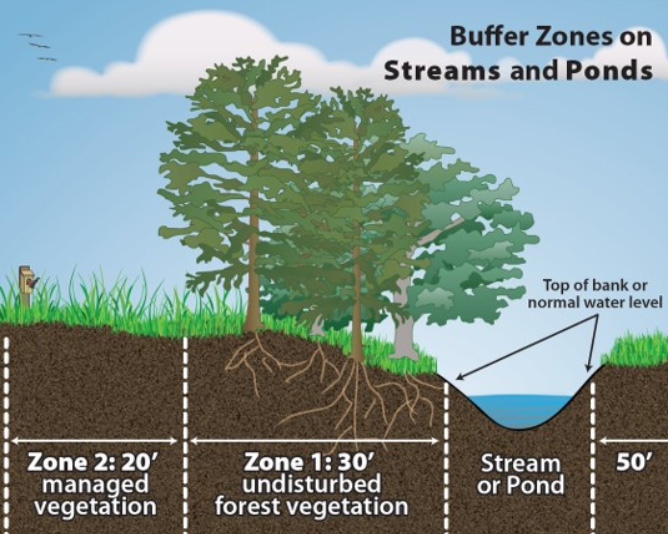
What is allowed in the buffers?
The riparian buffer must remain undisturbed, regardless of property size or type of land use, unless the use is listed in the rules as deemed allowable, allowable upon authorization, allowable with mitigation upon authorization, prohibited.
Under certain conditions, there are Exemptions when existing uses are present and ongoing. This Rule shall not apply to portions of the riparian buffer where a use is existing and ongoing. Refer to the specific rule for details. Neuse 15A NCAC 02B .0714 (6), Tar-Pam 15A NCAC 02B .0734 (6) Refer to the Table of Uses in the rules for specific activities.
- Deemed Allowable: allowed without approval from NCDWR or delegated local authority provided that the activity meets the provision listed in the table of uses
- Allowable upon Authorization: may occur only after written authorization from NCDWR or delegated local authority
- Allowable with Mitigation upon Authorization: may occur only after written authorization from NCDWR or delegated local authority with a mitigation strategy.
- Prohibited: not allowable unless a variance is granted form the N.C. Environmental Management Commission. Activities not listed are prohibited.
- Allowable with Exception: Activities not listed may be authorized by the Authority with a mitigation strategy.
Stormwater runoff into the riparian buffer shall meet dispersed flow as defined in 15A NCAC 02H .1002.

Photo by: F. Hahne - Mecklenburg Co.
What is dispersed flow?
Dispersed flow means uniform shallow flow that is conveyed to a vegetated filter strip as defined in 15A NCAC 02H 1059, another vegetated are, or stormwater control measure (SCM).
Purpose of dispersed flow Dispersed flow removes pollutants through infiltration and settling, as well as to reduce erosion prior to stormwater reaching surface waters. SCM designs can be found in the Stormwater Design Manual at https://deq.nc.gov/about/divisions/energy-mineral-andland-resources/stormwater/stormwaterprogram/stormwater-design.
Common Activities in the Buffer
Regulated activities in the Buffers are listed in the Table of Uses for Each Rule: deq.nc.gov/ncbufferrules.
Please read and understand the rule including the table of uses prior to beginning any activity within the buffer. Activities may be deemed allowable, require written approval, or prohibited.
Examples of Some Activites Listed in the Table of Uses of the Rules:
- Fences, if no woody vegetation is removes
- Fertilizing, only to establish replanted vegetation. Ongoing fertilization is not allowed.
- Playground equipment
- Removal of poison ivy or sumac and other invasive plants as listed in a specific document
- Periodic mowing in Zone 2
- Planting native vegetation to enhance the buffer
- Removal of trees that are in danger of causing damage to structures or human life
- Limited pruning of forest vegetation. See Pruning definition: 15A NCAC 02B .0610 (33)

Division of Water Resources Buffer Permitting Branch 1617 Mail Service Center | Raleigh, NC 27699-1617 (919) 707-3631
Page last updated: April 29, 2026